
Hip Labral Tear Treatment: Do You Always Need Surgery
If you’ve been diagnosed with a hip labral tear, you may be wondering if surgery is your only option. The good news is that many people with a hip labral tear recover successfully without surgery.
In fact, research shows that hip labral tears are common, even in people who have no hip pain at all. This means that an MRI finding doesn’t always tell the whole story.
What Is a Hip Labral Tear?
The labrum is a ring of cartilage that lines the socket of your hip joint. It helps provide stability and cushioning as you move.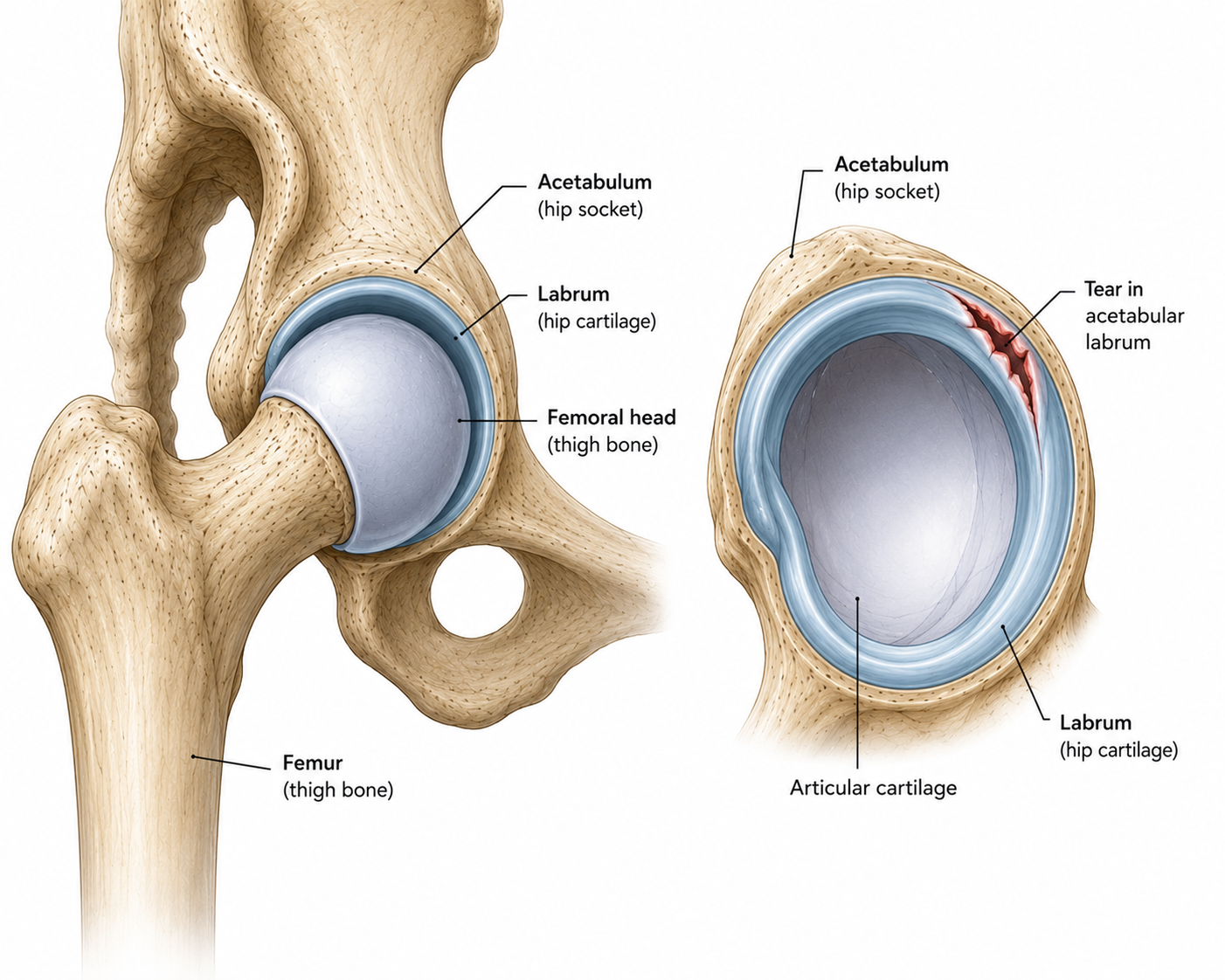
A labral tear can develop from:
- Sports or repetitive movements
- Hip impingement (FAI)
- Trauma or injury
- Normal age-related changes
Some people experience pain, clicking, stiffness, or catching in the hip. Others have a labral tear and never know it because it doesn’t cause symptoms.
What Does the Research Say?
A large systematic review published in the British Journal of Sports Medicine examined MRI findings in thousands of people with and without hip pain.
The researchers found that more than half of people without hip pain had a labral tear visible on imaging. In other words, labral tears are common and don’t always cause pain.
This is why healthcare providers should treat the person, not just the MRI. Your symptoms, physical examination, strength, mobility, and activity level are just as important as what shows up on a scan.
Can a Hip Labral Tear Heal Without Surgery?
While the labrum itself doesn’t always “heal” completely, many people can return to walking, exercising, working, and playing sports without surgery.
Physical therapy helps by:
- Improving hip strength
- Increasing mobility
- Reducing stress on the hip joint
- Improving balance and movement patterns
- Decreasing pain during daily activities and exercise through graded exposure
For many patients, these improvements are enough to return to the activities they love.
When Is Surgery Recommended?
Hip labral tear surgery may be appropriate if:
- Pain continues despite several months of physical therapy
- The hip repeatedly locks or catches
- Symptoms significantly limit daily activities or sports
- Your orthopedic specialist believes surgery is the best option based on your examination and goals
Even then, physical therapy is an important part of recovery before and after surgery.
Should You Try Physical Therapy First?
For many people, YES! Unless there is a serious injury requiring immediate surgical care, conservative treatment is often recommended before considering surgery.
A physical therapist can help temporarily modify activities that are irritating your hip while gradually increasing your exposure to those movements through a progressive loading program. This allows your hip to safely adapt, build tolerance, and return to higher-level activities with greater confidence.
The Bottom Line
A hip labral tear on an MRI does not automatically mean you need surgery. Many labral tears are found in people who have no pain at all.
If you’re experiencing hip pain, don’t let an MRI result make the decision for you. A thorough evaluation and a personalized physical therapy program can often help you reduce pain, improve function, and get back to doing the things you enjoy…without surgery.
Looking for hip labral tear treatment? Our physical therapists at Omaha Physical Therapy Institute can evaluate your hip and develop a treatment plan designed to help you move with confidence again!
Make an Appointment Today! »
Your Comeback Story Starts Here!